Apr 16, 2011

New Zealand North: The Land of the Tree

SWoBs Down Under: Episode 1

Aotearoa here we come!

When someone mentions New Zealand, you may think of sheep quietly grazing green pastures, steep mountains covered in snow falling precipitously to the sea, forests filled with birdsong, and sheep. This is exactly what NZ is, and so much more.

NZ also has the most rainbows of anywhere in the world, its a fact.

SWoBs journeyed to the Land of the Long White Cloud to seek those greener pastures, and the empty point breaks along their shores. We also wanted to check out what makes NZ so green- not only the grass, but the people and the country itself.

Pohutukawa trees are awesome. A little trek up Mount Maunganui.

Oh yeah... there are waves too.

Arriving in Auckland we were met by our two friends Becca Davis and Sara Stuart. We proceeded to procure a deal on a relocation of an RV to Christchurch, recently smashed by a tremendous earthquake that left 10,000 homes condemned.

Livin' off the land- wild apples anyone?

Following the winds and swell, we went East, to the Coromandel Peninsula and around the East Cape and down the east coast to the southern part of the North Island.

A Maori Marae on the East Cape.

The first thing that struck us was how much the people depend on the land. Small farms dotted the landscape, cows and sheep quietly grazed, and forests covered the hills. We were sad to notice however, that the land seemed overworked and overgrazed, and the forests were a large part a monoculture of non-native pine farms.

Not even NZ is free from the threats of offshore drilling.

The Monterrey Pine (Pinus radiata) was introduced to NZ from our home, California, in the 1850’s for windbreaks and hedgerows. It was noticed that the trees grew straight and fast (7 times faster in fact), and had few pests in their new home. Commercial plantations were planted out in the 1870’s, with modern breeding leading to new cultivars planted out in the 1970’s.

Aubrey on a solid one somewhere on the North Island, can't quite remember...

Pine forestry is NZ’s third largest industry, amounting to NZ$5 billion per year and employing 20,000 people. Seven percent of NZ is planted to pine forest, or 1.7 million hectares.

NZ has an incredible amount of natural resources for such a small place and with so few people. Water and land is abundant, and it would seem that there would be no end in sight, and predictions are that the forestry industry will “grow” even further.

Paua (NZ abalone) thrive in the rich waters.
Silting of rivers from deforestation could threaten the sensitive molluscs.


What’s wrong with Pine trees you may ask? Nothing really. Yet like most issues, the devil is in the details

Pine Forest establishment starts out with spraying herbicides to create open soil from unused land or pasture, in both cases once native forest. Around 75% of NZ native forests have been logged, as NZ was renowned for quality timbers such as Kauri (Agathis australis), which fed a growing population in both the home country and Australia.

A common site on NZ roads, trucks loaded with pine logs.

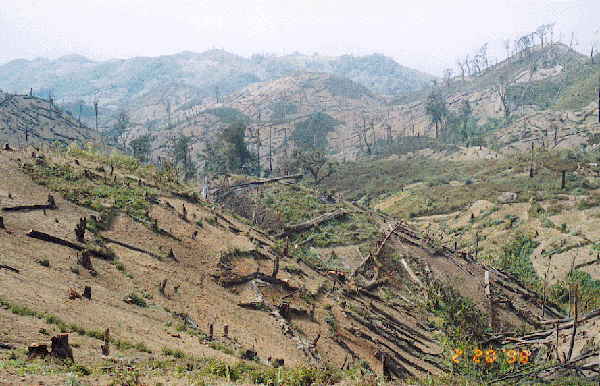
Deforestation coupled with high rainfall has led to serious degradation of soils through erosion. Many sites were deemed unusable after slash and burn harvesting. Even today, the pine forest plantations are clear-cut, with resultant soil loss, which affects fisheries and groundwater reserves.


The common practice of harvesting pine plantations is clear cutting using heavy equipment which scars the land.

Often, pine forests are the only viable alternative to land-owners with degraded sites. Carbon Credits are sold on the open market to cover planting costs, yet the credits must be paid back upon harvest, so the credits are like a loan. Carbon sequestration is halted when the forest is cut, so it is debatable whether this is truly a solution for combating green house gasses.

Another empty one...

Another issue is that of genetic engineering. A NZ company was recently granted permission to plant a research plot of GM pines infused with the genes of the bacterium, Bacillus thuringiensis, or Bt, to combat insect pests.

This guy isn't too keen on genetic engineering...

The jury is still out on the positive or negative effects of transgenic organisms on people and other life forms. More research is definitely needed before releasing these genes into the environment. This also presupposes that industry intends to patent pine trees, making it illegal to propagate them, further creating an agribusiness monopoly.

After harvest (every 28 years), one third of NZ timber is shipped out via sea in log form, with a majority of NZ timber ending up in China and other Asian countries. It is estimated that almost 10 million cubic meters of timber was exported in 2010. That amounts to 250 million kgs, or 625 million pounds of carbon exported out of NZ, directly from their soils and air (click for calcs). Take that out of the carbon credit budget.

Logs ready for shipping out in Gisborne harbor. NZ supplies almost 2% of the worlds' wood supply.

So in reality, NZ is exporting a large percentage of their soils when they export wood. This further leads to degradation of soil structure.

Aubrey and Becca met up with their friend Niki in the surf randomly... small world! Niki is a local charger and environmental activist who lives on the East Coast of the North Island.

It is no doubt that most Kiwis would prefer to preserve and protect their land if given the option. People we met were proud of their country and were aware of the rest of the world’s view of their green islands. Untold economic pressures have forced people to push much of their land to the brink, and the future of their country may hang in the balance.

Its all about the set up...

We are not implying that farming pines is evil- it is far better than grazing or intensive farming. Furthermore, NZ is indeed better suited to growing wood than other countries, but at what cost?

The worlds’ demand for wood is ever increasing, and NZ is just supplying a need for timber to build homes in countries that cannot provide their own wood for construction. Other options exist, however, for both carbon credits and materials for home building.

Lots of wind turbines in the land of lots of wind.

We always try to look at both sides of the issue, and suggest solutions that are a win-win. Building from natural and local materials is always preferred to imported materials. Cob construction, building from the earth, is a viable option, even in NZ. We visited a cob home built in the 1850’s that is still standing and lookin’ good.

Cob house built in the 1860's.

If we promote truly sustainable building, we can reduce our need for imported and exported wood, and NZ soils and water reserves will benefit. Native forest that is not harvested sequesters far more carbon and provides many more ecological benefits like improved habitat for endangered species and groundwater infiltration.

Fortunately, there are several options for land-owners who wish to promote native forest regeneration. The Permanent Forest Sink Initiative creates funding for the planting of native trees, and several organizations offer services to sell carbon credits for native forests.
(click for video of carbon farming with native trees)

Sara, Aubrey, and Becca checkin' it.

New Zealand indeed leads the world in many areas, including environmental protection. Unfortunately the global market has made carbon a commodity, and financial gains often outweigh true sustainability.

If we can incentivize the planting of native trees, and also promote natural building, NZ and the world will benefit, as opposed to short-term gains that really benefit nobody in the long run.

The long walk to surf...

We finally made it to Wellington and parted ways with our friends Becca and Sara. Sara is looking into graduate schools in NZ for Environmental Science and Management. She works in Hawaii protecting native plants and birds, and has chosen NZ as a place to further her career in land stewardship.

Really crazy seaweed... full of air pockets like bubble wrap.

Nature has thought of it all, and never ceases to amaze...

SWoBs are now traveling to the South Island and Christchurch, which continues to have after shocks of significant size. We hope to help the people of this historic town in any way we can… stay tuned!


Links:
Carbon Credits from Native Forests:
http://www.nzgreen.org.nz/how_it_works
http://www.ebex21.co.nz/

Video of carbon farming:
http://www.youtube.com/watch?v=zDcUJxuwQws&feature=player_embedded#at=16

Permanent Forest Sink Initiative:
http://www.maf.govt.nz/forestry/funding-programmes/permanent-forest-sink-initiative.aspx

Feb 14, 2011

Plastic to Oil!


For the past several years, Surfers Without Borders have been researching various methods of producing energy from waste. While there are many clean ways to get electricity from biomass or organic matter, we were particularly looking for ways to create an incentive for people to clean up the ocean, mainly the plastic that has gathered itself and our attention in the Northern Pacific Gyre.

The Northern Pacific Subtropical Convergence Zone
aka the Pacific Garbage Patch

There are more convergence zones than the Pacific Garbage Patch, and a total of 5 major gyres. We now know with reasonable certainty that plastic is indeed accumulating in all of these areas of the ocean.

"Geez, Professor, thatsalotta plastic...
Could it be worth something?"
After all, its made from oil- isn't it?

After many sessions surfing the internet, we came across a pretty promising process and series of machines designed by the Blest Corporation of Japan. After contacting them we were put in touch with their US representatives, E-N-ergy Inc.

Jason Tanne, Harry, and Rod Sato of E-N-ergy

This last week, E-N-ergy visited Surfers Without Borders at the Orella Stewardship Institute to demonstrate the innovation that turns common household plastics into usable oil (click here to watch the video of the demonstration- 3 parts). The machines range from a small desktop units to large continuous processing machines and refiners that can handle up to multiple tons of plastic waste.


Over 50 people came out to view the Plastic to Oil demo
hosted by Orella Stewardship Institute


The Blest Be-h desktop unit was on hand converting plastic grocery bags, milk and water jugs, margarine and yogurt containers into oil that can run generators and other engines. The desktop unit is ideal for classrooms, small offices or home use. (click here to watch a video of the process)


Cutting up an old tupperware for processing


Plastics of type #2, #4, #5, #6 and some #7 are usable, including bags, wrappers, and other thin film plastics that are not recyclable (which are also the most damaging to the environment).

The plastics are put into the melting chamber where they are heated to around 420 deg C, at which point the plastic boils and the hot gasses are run through a water bath to be condensed into oil.


The machine in action- the cylinder on the right contains the gas from plastic that has

heated and is being condensed through normal tap water


Touchscreen makes for easy operation


The desktop unit uses 1 kilowatt of electricity to convert 1 kilogram of plastic into 1 liter of oil, at a cost of around US $0.25. The oil can then be further refined back through the same machine into gasoline, kerosene, and diesel. A small amount of ash is left over, and the off-gasses are turned into CO2 and water with a catalytic converter, or can be used to run a generator.

The process is called pyrolysis- and is a tried and true method for converting almost any type of material into energy. Material is super heated in the absence of oxygen- so does not combust, but vaporizes into gas. Since there is no combustion, the process is relatively clean.


Mark Morey and Glenn of SB Surfrider talk with Harry of E-N-ergy


Joining us for the demo were representatives of various interest groups in Santa Barbara, including the City and County solid waste managers. SWoBs is trying to bring together all of the players in our area who have the influence to bring this technology to our area.


Rod Sato of E-N-ergy in blue on left talks with (l to r) Carlyle Johnston and Mark Tautrim of SB County Public Works Waste Management Division, and Eric Lohela, Environmental Specialist with the City of SB Recycling and Trash Division. In the background are Russ Teall of BioDiesel Industries and Micheal Chiacos of the Community Environmental Council.


Santa Barbara County just recently put out a bid for waste conversion technologies, as our landfill is over 50% capacity and we need to start looking at alternatives to dumping our trash into a hole in the ground. This process seemed promising, with a City employee stating he was "Cautiously optimistic."


The Blester Be-h desktop unit

The oil is visible as the upper dark layer of liquid in the cylinder on the right


While this technology is not a silver bullet for the issue of marine debris, it is a start. The real value of this process is to demonstrate that plastic is a resource, even that which cannot be recycled, like all those silly bags of corn chips and candy bars.


Furthermore- we are not implying that we should continue to use more and more plastic because we can convert it to fuel. This technology offers one solution for plastic that is already in circulation, particularly that which is circulating the globe in the ocean. We must also continue to look at replacing plastics with other biodegradable or benign materials, like wax paper.


If we as humans can shift our perception of “waste”, we can create jobs that clean up the planet. If we consider our trash as treasure, people will think twice about throwing things “away”, wherever that is.


Read more about Blest machines and the process at E-N-ergy's blog:

http://www.e-n-ergy.blogspot.com/

Oct 9, 2010

10-10-10: Can We Save the World?

Does the world even need saving?
With all of the global crises lately- global warming, plastic in the ocean, oil spills- it sure seems that way. But the Earth will most likely not die or disappear if these crises remained unaddressed- but we will, just like the Dodo.


Every gallon of oil in the ocean, every degree the Earth heats, just makes life a little more difficult for us, not to mention the myriad species of plants and animals that are not as adaptable as humans. And nobody wants more challenges, more difficulty, or more stress.

So what we are really talking about is preservation- preservation of a quality of life, as well as species and habitats. But we must go beyond preservation at this point- just merely keeping the status quo is not enough. We must regenerate what we have destroyed in order to re-create the natural bounty enjoyed by our ancestors.

Tomorrow is 10-10-10
This day was selected by the folks at 350.org to challenge people to reduce their carbon footprint by 10% in the next year, with the goal to drop global CO2 concentrations to pre-industrial levels of 350 ppm.

Take the 10-10-10 challenge and join an existing event, create your own, or take the personal pledge to reduce you own emissions over the next year.

3 (incredibly easy and fun) ways you can reduce your CO2 footprint:

1. Grow (at least some of) your own food:
Planting a garden is not only funner and fresher, you also cut out an incredible amount of CO2 by reducing food miles.


Did you know that the average salad travels 1500 miles on its way to your table?


Speaking of salad, a mostly vegetarian diet creates far less greenhouse gasses (unless you eat a lot of beans...) If you can't grow your own, support a local farmer.


2. Dry your clothes on a line instead of the dryer.


Just like Grandma used to do... Do you think she was stupid? She knew that she could save money by using good ol' fashioned solar energy to get her whites whiter.


Not only can you save money, but you could keep around 1000 pounds of CO2 out of the atmosphere by line-drying for only six months out of the year!


You can even dry your clothes indoors in the winter if you are super core...


3. Walk, bike, or stay at home.
This is kind of a no-brainer, but the less you drive, the less CO2 you produce. Unfortunately, the current trend is more single drivers and less carpooling.


In today's age of hyper-cyber-connectedness, many people can work from virtually anywhere. If you can't, carpool with a friend, or that cute someone from the office.


Maybe talk to your boss about working more hours and less days. If we worked four ten-hour days we could cut out 20% of our CO2 emissions from commuting, or around 1250 pounds of CO2 per year per person.


It really isn't hard, inconvenient, or boring to reduce your impact on the planet. In fact, you will feel better, be healthier, and appreciate what you have even more than you do now.


Upcoming events...

October 10th: Carrot Mob "Buycott" at McConnell's Ice Cream on Sunday from 1-4 pm.

Come out and support the "Buycott" at McConnell's Ice Cream on the corner of Mission and De La Vina Streets in Santa Barbara. McConnell's has agreed to use all extra proceeds generated from the "mob" to improve energy efficiency in their store. Sounds like a sweet deal!

October 15th-17th: Central Coast Bioneers

Bioneers is inspiring a shift to live on Earth in ways that honor the web of life, each other, and future generations. Bioneers has two keystone goals to help make this shift successfully:

Connect people with solutions by popularizing breakthrough ideas and practices, and grow social capital by catalyzing, connecting and strengthening strategic networks, including bioregional and community based alliances.

SWoBs Founder Loren Luyendyk will be tabling at the event. Email info@surferswithoutborders.org for more info

October 16th: Santa Barbara Surfrider Paddle-Out for Clean Waves
from 11 am to 3 pm at Ledbetter Beach. Food, music, and games also!

contact Ken Palley at 2palleys@cox.net for more info.


October 20th: "Last Paradise" Film

$10 general admission/$20 Center for Sustainability Supporters
Tickets at the door, or Arlington Ticket Office(805) 963-4408

An Eco-Adventure Film 45 years in the making with stunning original footage from Bali, Mexico, Portugal, New Zealand, Utah, and Australia. Young maverick sports pioneers exploring a world that no longer exists, meeting along the way surf legends, extreme sports pioneers, and scientists on the leading edge of alternative energy. Clive Neeson, extreme sports pioneer, filmmaker & physicist will be available for Q&A following the film.

contact: Margie, msbushman@sbcc.edu, (805) 965-0581, ext 2177 for more info

October 23rd: Friendship Paddle
from Santa Cruz Island to Chase palm Park, event to follow

Seven years ago, a group of friends formed The Friendship Paddle as a way to help a friend, Doug McFadden, battle an inoperable brain tumor. In doing so, this group of friends raised funds and spirits for Doug and his family via a relay paddle across the Santa Barbara Channel.


Following that initial success, The Friendship Paddle has held a new event each year to support a family in need. To date, with each member raising money for the paddle, the group has been able to provide financial and emotional support to seven special families who have faced life-threatening illnesses. The memories and the legacy created by this annual event had a very powerful and positive effect on the families and participants involved.


contact Alex Pappas at mystic_tubes@hotmail.com for more info

October 29th: "Nightmare at Gaviota"

SB Surfrider benefit for the Gaviota Coast, SoHo Restaurant and Music Club with special guests Makai


Last but definitely not least....

Our friends at Quail Springs Learning Oasis and Permaculture Farm just suffered a devastating flood that wiped out their pond and gardens, amongst other things. All told the deluge took out $40,000 worth of infrastructure, not to mention the 1000's of hours of work lost over the last six years of soil building. Please support them any way you can, by donating time or money to our wonderful family out in Cuyama.

Please contact info@quailsprings.org to help


wow... that was a long one. Thanks for hangin' in there if you made it this far. Until next time....


KEEP IT CLEAN!