Showing posts with label Organic Farming. Show all posts

Jul 25, 2011

Permaculture New Zealand

What does it take to take care of ourselves?

Sustainability is a real buzz-word, used to the point of exhaustion. But truthfully a lot of what we hear about sustainability is just a ploy to sell us something, some new product that is “green” or “eco”.


So what is sustainability? From Wikipedia: “Sustainability is the capacity to endure. In ecology, the word describes how biological systems remain diverse and productive over time.”

So in a sense, only Nature is truly sustainable.

So how do we create systems that remain diverse and productive over time? By mimicking Nature.


However, it seems like the world is going the opposite way, with WalMart selling the same products the world over, and Monsanto creating foods that are not only foreign in nature, but are genetically identical and proprietary. On top of that, they are planting these experimental crops in pristine and sensitive places, like Hawaii, polluting local seed-stock forever.

And now the US Organic Elite has surrendered to agricultural giant Monsanto and their Frankenfoods. In a statement released recently, Organic Valley, Stonyfield Farms, and Whole Foods said that we must accept GMO’s (genetically modified organisms), and work with them.

What? Did I really read that?

Turns out over 2/3rds of Whole Foods’ products contain GMO’s, unlabelled.

This is not healthy food. Boycott these companies.


Perhaps 10% of the world feeds itself. The rest of us rely primarily on centralized distribution from industrial farms (organic included). And the same goes for our water and energy supplies. This is a sticky situation.


On the contrary, Kiwis are historically self-reliant, in particular with respect to feeding themselves. New Zealand is particularly suited to growing a wide variety of crops, thanks to a mild climate, good soils, and abundant water. The Maori were (and still are) incredible farmers, growing produce for the new colonies in the South Pacific.

We felt like we were on the set of Lord of the Rings...

We had a chance to visit some amazing places and farms that are re-creating local economy and regional resilience.


Lothlorien Winery was the first Certified Organic orchard in New Zealand, back in the ‘70s. Started by Dale Demulemeester and friends, they decided to plant peaches and feijoas (pineapple guavas). The peaches sold great, but soon went out of production. The feijoas continued to thrive, so they planted more.
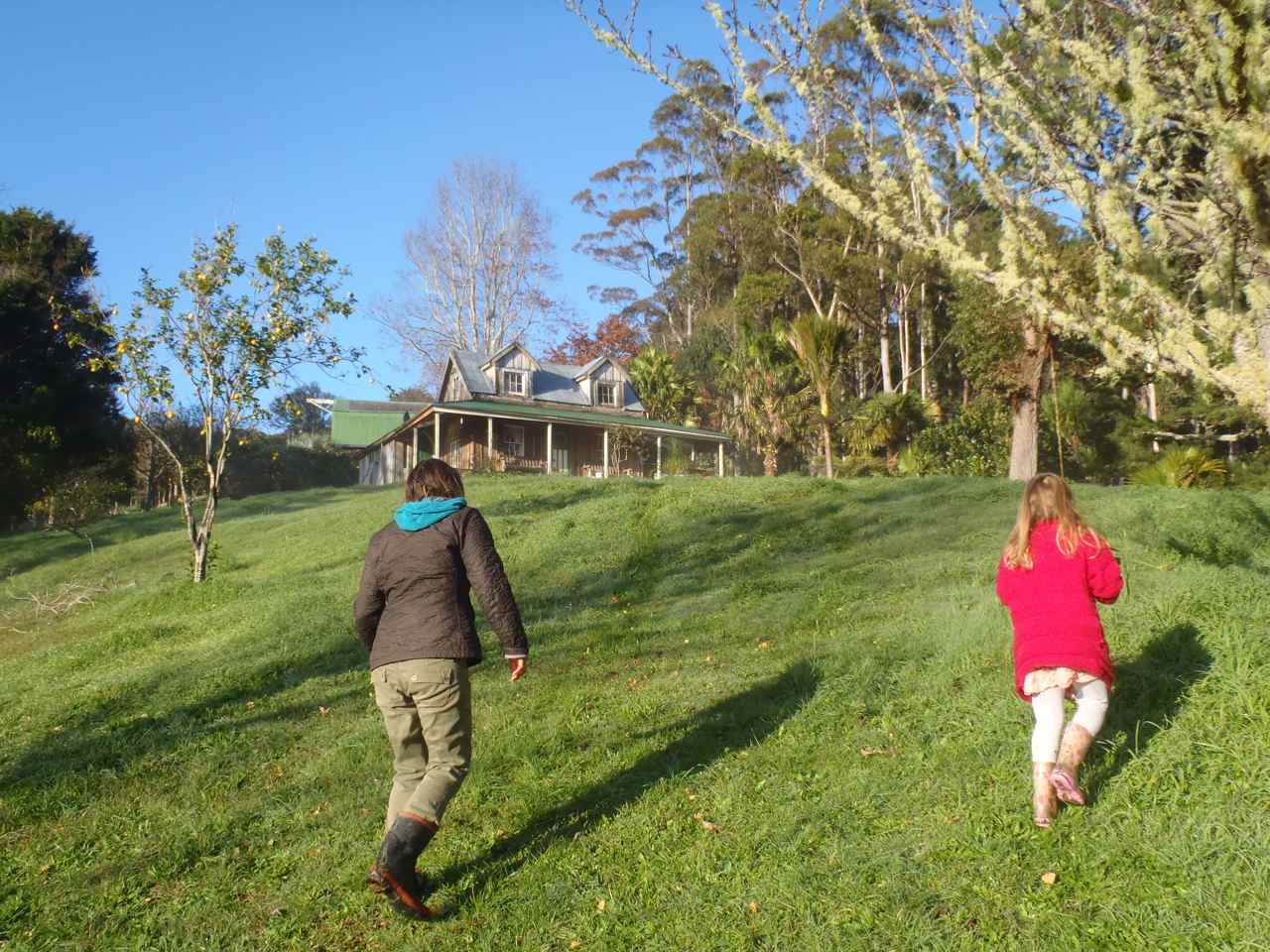
No roads to the house is quite refreshingThe "fridge"Jo grows bananas, in NZ!
Dale and a little milk for your coffee, straight from the udder

Now many hundreds of seedling trees are gracing the gently slopes of the Puhoi Valley. These trees are all genetically different from each other, and this imparts disease resistance to the farm and also a fine flavor to their wine. That’s right, organic sparkling feijoa wine.

Unfortunately you will have to travel to NZ to sample- no exports :(

While alcohol may be a luxury, lets be frank, it can be medicinal. One sip of this amazing concoction puts an ear-to-ear grin on your face. Best of all, its organic, truthfully.

Eli Demulemeester and a crate of liquid gold

Wine is not the only crop at Lothlorien. They have many citrus, pecan, macadamia, banana, avocado, a dairy cow, chickens, and vegetable gardens tended by Dale’s wife Jo. They also planted pines and eucalyptus on barren slopes 30 years ago, and now they are being harvested by the next generation to build their homes.

Eucalyptus flooring grown on site

What is behind the doors we left for the next generation?

Three generations of the Lothlorien clan live and work on the farm, tending trees and making wine. Eli and his brother and sister along with their families are taking the reigns of the farm from Dale.

Koko, Kim, Eli, and Tally Demulemeester

We then made our way south to Whaingaroa, the harbor more known for its surf spot than sustainability movement. Turns out its quite a little pocket of regional resilience.


Local crew are stepping up, with city parks turning into food forests, and organic farms popping up all over the region. They are also looking into microfinance and waste issues.

A young food forest in a local city park

Xtreme Waste was conceived by Liz and Rick Thorpe, the goal to reduce the local waste stream to zero. This is a feat in itself, deserving a separate blog entirely. As if this wasn’t enough to keep them busy, they also double as small-scale permaculture farmers.


Mixed fruit orchards surround a beautifully hand made house, ducks grazing beneath to keep the growth at bay and provide eggs. They plant vegetable crops like garlic, which we helped to separate for planting in a family style community atmosphere. They open the farm up every Tuesday to anyone who wants to come out and help.


Community is the cornerstone to local resilience, and this is also demonstrated in a big way at Kaiwhenua Gardens, run by Lynne and Kaiwaka Riti. Kaiwhenua translates directly to “Land of Food”, and Kaiwaka is the “Canoe of Food”, feeding the local whanau, family.

Kaiwaka Riti, tupuna of organics
Kai Whenua Gardens- Land of Food

Kaiwaka has started a revolution in the local area, by empowering young Maori who have lost their culture to the culture of the street and gangs to get back on the land and cultivate it. It is an amazing thing to see his passion and inspiration for his culture or whakapapa.

We arrived at Kaiwhenua the same time as local school kids came to get their hands dirty. We weeded around, and sampled delicious young carrots.

Possibly more eating than weeding took place...

We got a tour and met the kunekune pigs, who were happily weeding out kikuyu grass from under some trees. Kunekune are traditional Maori pigs, and are the only breed that can live off of grass exclusively.

Possibly the ugliest, and cutest animal at the same time

Kaiwhenua is also part of a new certification structure based on traditional Maori values. Hua Parakore, Pure Produce is a movement to take back the organic food standards from corporate interests.

Keepin' it Clean and Green in NZ!

Just down the road at the base of the point is another example of a community in action, this time an eco-retreat turned Permaculture Demonstration Site called SolScape.

Phil McCabe of SolScape holds up on of his experimental Earth Bricks

SolScape has been run by Phil and Bernadette McCabe for the last ten years as a backpackers with an eco twist, and now they are ready to take it to the next level. A collaboration with Otago University created the Practical Sustainable Living curriculum to be taught on site overlooking the majestic Tasman Sea.

Cool Caboose room

The property is 10 acres of mixed native bush and accommodation, with more and more vegetable gardens replacing the grass, and chickens running free. Recycled cabooses make cool rooms, and communal kitchens have earthen ovens built during Permaculture Design Courses.


We had a chance to join Phil for a tour with a group of American high school students with Global Adventures. We saw the eco-batch made from local and recycled materials, the earth bag domes, and the tipi site with solar hot water and composting toilets.


SWoBs is in discussion with SolScape about hosting Permaculture Surf Retreats on site. Participants will surf in the morning and learn in the afternoon, and a project will be created in the local community to help with local resilience. Stay tuned for more!

We got our hands dirty while in Waikato

We also wanted to mention our new friends with NZ Surf Tours, Judd and Ramona. We had the fortune of meeting them at Ahipara as hosts at the Endless Summer Lodge. Look them up and you are guaranteed to have a great adventure in Northland!


That's all for now, thanks for reading!

Apr 16, 2011

New Zealand North: The Land of the Tree

SWoBs Down Under: Episode 1

Aotearoa here we come!

When someone mentions New Zealand, you may think of sheep quietly grazing green pastures, steep mountains covered in snow falling precipitously to the sea, forests filled with birdsong, and sheep. This is exactly what NZ is, and so much more.

NZ also has the most rainbows of anywhere in the world, its a fact.

SWoBs journeyed to the Land of the Long White Cloud to seek those greener pastures, and the empty point breaks along their shores. We also wanted to check out what makes NZ so green- not only the grass, but the people and the country itself.

Pohutukawa trees are awesome. A little trek up Mount Maunganui.

Oh yeah... there are waves too.

Arriving in Auckland we were met by our two friends Becca Davis and Sara Stuart. We proceeded to procure a deal on a relocation of an RV to Christchurch, recently smashed by a tremendous earthquake that left 10,000 homes condemned.

Livin' off the land- wild apples anyone?

Following the winds and swell, we went East, to the Coromandel Peninsula and around the East Cape and down the east coast to the southern part of the North Island.

A Maori Marae on the East Cape.

The first thing that struck us was how much the people depend on the land. Small farms dotted the landscape, cows and sheep quietly grazed, and forests covered the hills. We were sad to notice however, that the land seemed overworked and overgrazed, and the forests were a large part a monoculture of non-native pine farms.

Not even NZ is free from the threats of offshore drilling.

The Monterrey Pine (Pinus radiata) was introduced to NZ from our home, California, in the 1850’s for windbreaks and hedgerows. It was noticed that the trees grew straight and fast (7 times faster in fact), and had few pests in their new home. Commercial plantations were planted out in the 1870’s, with modern breeding leading to new cultivars planted out in the 1970’s.

Aubrey on a solid one somewhere on the North Island, can't quite remember...

Pine forestry is NZ’s third largest industry, amounting to NZ$5 billion per year and employing 20,000 people. Seven percent of NZ is planted to pine forest, or 1.7 million hectares.

NZ has an incredible amount of natural resources for such a small place and with so few people. Water and land is abundant, and it would seem that there would be no end in sight, and predictions are that the forestry industry will “grow” even further.

Paua (NZ abalone) thrive in the rich waters.
Silting of rivers from deforestation could threaten the sensitive molluscs.


What’s wrong with Pine trees you may ask? Nothing really. Yet like most issues, the devil is in the details…

Pine Forest establishment starts out with spraying herbicides to create open soil from unused land or pasture, in both cases once native forest. Around 75% of NZ native forests have been logged, as NZ was renowned for quality timbers such as Kauri (Agathis australis), which fed a growing population in both the home country and Australia.

A common site on NZ roads, trucks loaded with pine logs.

Deforestation coupled with high rainfall has led to serious degradation of soils through erosion. Many sites were deemed unusable after slash and burn harvesting. Even today, the pine forest plantations are clear-cut, with resultant soil loss, which affects fisheries and groundwater reserves.


The common practice of harvesting pine plantations is clear cutting using heavy equipment which scars the land.

Often, pine forests are the only viable alternative to land-owners with degraded sites. Carbon Credits are sold on the open market to cover planting costs, yet the credits must be paid back upon harvest, so the credits are like a loan. Carbon sequestration is halted when the forest is cut, so it is debatable whether this is truly a solution for combating green house gasses.

Another empty one...

Another issue is that of genetic engineering. A NZ company was recently granted permission to plant a research plot of GM pines infused with the genes of the bacterium, Bacillus thuringiensis, or Bt, to combat insect pests.

This guy isn't too keen on genetic engineering...

The jury is still out on the positive or negative effects of transgenic organisms on people and other life forms. More research is definitely needed before releasing these genes into the environment. This also presupposes that industry intends to patent pine trees, making it illegal to propagate them, further creating an agribusiness monopoly.

After harvest (every 28 years), one third of NZ timber is shipped out via sea in log form, with a majority of NZ timber ending up in China and other Asian countries. It is estimated that almost 10 million cubic meters of timber was exported in 2010. That amounts to 250 million kgs, or 625 million pounds of carbon exported out of NZ, directly from their soils and air (click for calcs). Take that out of the carbon credit budget.

Logs ready for shipping out in Gisborne harbor. NZ supplies almost 2% of the worlds' wood supply.

So in reality, NZ is exporting a large percentage of their soils when they export wood. This further leads to degradation of soil structure.

Aubrey and Becca met up with their friend Niki in the surf randomly... small world! Niki is a local charger and environmental activist who lives on the East Coast of the North Island.

It is no doubt that most Kiwis would prefer to preserve and protect their land if given the option. People we met were proud of their country and were aware of the rest of the world’s view of their green islands. Untold economic pressures have forced people to push much of their land to the brink, and the future of their country may hang in the balance.

Its all about the set up...

We are not implying that farming pines is evil- it is far better than grazing or intensive farming. Furthermore, NZ is indeed better suited to growing wood than other countries, but at what cost?

The worlds’ demand for wood is ever increasing, and NZ is just supplying a need for timber to build homes in countries that cannot provide their own wood for construction. Other options exist, however, for both carbon credits and materials for home building.

Lots of wind turbines in the land of lots of wind.

We always try to look at both sides of the issue, and suggest solutions that are a win-win. Building from natural and local materials is always preferred to imported materials. Cob construction, building from the earth, is a viable option, even in NZ. We visited a cob home built in the 1850’s that is still standing and lookin’ good.

Cob house built in the 1860's.

If we promote truly sustainable building, we can reduce our need for imported and exported wood, and NZ soils and water reserves will benefit. Native forest that is not harvested sequesters far more carbon and provides many more ecological benefits like improved habitat for endangered species and groundwater infiltration.

Fortunately, there are several options for land-owners who wish to promote native forest regeneration. The Permanent Forest Sink Initiative creates funding for the planting of native trees, and several organizations offer services to sell carbon credits for native forests.
(click for video of carbon farming with native trees)

Sara, Aubrey, and Becca checkin' it.

New Zealand indeed leads the world in many areas, including environmental protection. Unfortunately the global market has made carbon a commodity, and financial gains often outweigh true sustainability.

If we can incentivize the planting of native trees, and also promote natural building, NZ and the world will benefit, as opposed to short-term gains that really benefit nobody in the long run.

The long walk to surf...

We finally made it to Wellington and parted ways with our friends Becca and Sara. Sara is looking into graduate schools in NZ for Environmental Science and Management. She works in Hawaii protecting native plants and birds, and has chosen NZ as a place to further her career in land stewardship.

Really crazy seaweed... full of air pockets like bubble wrap.

Nature has thought of it all, and never ceases to amaze...

SWoBs are now traveling to the South Island and Christchurch, which continues to have after shocks of significant size. We hope to help the people of this historic town in any way we can… stay tuned!


Links:
Carbon Credits from Native Forests:
http://www.nzgreen.org.nz/how_it_works
http://www.ebex21.co.nz/

Video of carbon farming:
http://www.youtube.com/watch?v=zDcUJxuwQws&feature=player_embedded#at=16

Permanent Forest Sink Initiative:
http://www.maf.govt.nz/forestry/funding-programmes/permanent-forest-sink-initiative.aspx