Showing posts with label surf trip. Show all posts

Nov 13, 2011

Baja Surf and Service

Baja California residents live a pretty good life, at least the ones who live outside the major borders cities of Tijuana, Rosarito and Ensenada. Overcrowding and poor sanitation plague these areas, along with violence perpetuated by drug cartels. It is not always a pretty sight…

Some pretty sketchy looking and smelling water after a little rain in Tijuana

Several hours south of Ensenada, away from the overflowing sewage systems and the shadow of drug lords, lies the peaceful ocean-side town of Ejido Erindira. A farming community, residents enjoy the bounties of both the land and sea, though tuna farming in Ensenada has impacted local fisheries, as baitfish are indiscriminately harvested for tuna feed.

Looking South from the hill over town

Erindira has a population of around 2000 people, and previously lacked adequate medical facilities to treat the locals. People needing treatment had to make the over 2 hour trip to Ensenada. This all changed several years ago when the Palomar chapter of the Flying Samaritans opened a medical clinic to service the local community.

The local constable with the ribbon un-tying ceremony

We were invited to join the Flying Samaritans for the inaugural opening of a dental clinic, the second part of a comprehensive health plan for the town. The clinic is the result of many years of hard work, and lots of donated dental equipment.

Oswin Schandera making last minute adjustments and clean-up before the big day

Our team was led by Verena Schandera, a medical student at UC San Diego, her parents Oswin and Kristina, and Ethan Fox, a practicing dentist. Verena’s fellow medical student and friend Tyler Morrison invited SWoBs Founding director Loren Luyendyk and practicing Chinese Medical Doctor Brian Falk to join them.


Saturday morning we dawn patrolled the clinic. People were already lined up to receive free dental care, and we proceeded to admit them. We processed 50 patients, but needless to say that was far too many for Ethan to treat in one day. Obviously dental care is a real need for this community.

Tyler Morrison taking pulses

Verena Schandera and Ethan Fox with a lucky patient!

While Ethan drilled and pulled teeth, Brian performed the less invasive work of treating people with acupuncture. The locals were very receptive to this kind of therapy, and found the results promising.

Brian Falk performing acupuncture

Loren Luyendyk helped to admit patients and taught children about dental hygiene

The night after the big day we were treated to a meal of local authentic Baja Fish Tacos. Local clinic volunteers Alonso and Linda prepared a meal fit for kings and queens, or doctors and dentists in this case…

¡Bien Sabroso!


We had the pleasure of staying at a super-chilo hostel by the sea called Coyote Cal’s. Overlooking the bay and the coast to the south, the hostel boasts super luxurious accommodations and awesome outdoor spaces.

Coyote Cal's at sunrise

Following the clinic day, we had a chance to explore the coastline north of Erindira. Miles of rugged cliffs punctuated by isolated and empty coves tempted us to jump in the sea. We found a promising little break and had a few waves to ourselves before our journey back home.

Brian Falk, Tyler Morrison, and Loren Luyendyk

Reflecting on the needs of the community, we realized that they may have all they need, now that the two clinics were operational. The challenge is staffing. Still, people seemed happy and healthy. One thing that struck us however was that only a few people in the town were growing food.

One house had some swales to catch water. They had mangoes, guavas, bananas, olives, figs, and nopales.

A California company leases the community land for vegetable farming, and according to anecdotal reports, they are happy to share the crops with locals as long as they don’t strip the fields. Though we also heard that they pay low wages and do not offer health care, hence the clinics.

Those are fields of cabbage headed to California

Baja is more of a desert than California, and wells are dug deeper every year. Furthermore, food comes in from afar and is not always during winter months due to poor road conditions.

Dudleya sp.

We are planning a rainwater harvesting installation at the clinic, coupled with a rain garden filled with edible plants. We hope to stimulate the idea of rainwater harvesting and home-scale food production with a simple system composed of parts that are inexpensive and readily available in the town.

Ephedra sp.. Medicinal plants were growing wild on the outskirts of town

Our next trip is on the 16th and 17th of December 2011. Please contact us at surferswithoutborders@gmail.com if you would like to join us on another journey for Surf and Service!

Oct 11, 2011

Save the Humans!

TransparentSea II
The Voyage of Surfers For Cetaceans (S4C)
http://www.transparentseavoyage.com/

Whales and dolphins are majestic creatures, no doubt. They are the romanticized elders of the ocean, teachers in silent ways to their human children. They are also indicators of our stewardship of the planet, showing us how we relate to the ocean and its creatures.

Trimarans at the ready for the TransParentSea Voyage

They are not immune to our influence. Commercial whaling and dolphin kills continue to this day in most parts of the world. Many people rely on whale and dolphin meat for food, and many other useful products come from them.

Dolphin-safe sailing with the S4C crew

They are other sources for these products, however. Much more sustainable and humane sources. Mainly from plants.

Did you buy anything on that ship?

In Southern California, the issues facing whales and dolphins are not from spear and harpoon, but from Chinese trinkets and giant ships. Due to the protection of these species in our waters, their populations have grown, along with humanity's use of their home the sea.

There has been an increase in whale strikes in recent years due mostly to the large container ships that transport goods in the global marketplace. California shipping lanes have become the feeding ground for an increasing number of blue whales, due to large populations of krill in theses areas.

Dave Rastovich and Kristi Birney, Marine Conservation Analyst with the EDC

A Santa Barbara organization, The Environmental Defense Center spoke at the recent launch party for Surfers For Cetaceans (S4C) about the issue of whale strikes in the Santa Barbara Channel, and what we can do about it.

Turns out the whales are being struck by the very container ships that bring goods to us from other lands. Four blue whales were confirmed killed due to ship strikes last year, though the number is thought to be higher.

Sandy Lejeune from SB Surfrider tells Dave of the development issues affecting the Gaviota Coast

So, the more food and trinkets we buy from overseas, the more whales are in danger from being hit. Seems like a good reason to buy local and grow your own?!?

In that vein SWoBs are launching a hands-on workshop series to address the issue of relocalization, and how sustainability can help the whales, oh, and the humans too!

The Crew about to launch from Gaviota State Beach

During the beach clean-up prior to launch we found tons of trash stuck in the bushes!

S4C embarked on the TransParentSea Desert Whale Voyage on the 1st of October from Gaviota State Beach near Santa Barbara. The voyage is a multi-media journey including sailing, surfing, music, art, and education about whales and the ocean.

SWoBs Founder Loren Luyendyk and S4C Crew member and pro surfer Chris Del Moro just about to launch

SB Local Chad Koenig has paddled the channel before, and is doing it again. All the way to Mexico!

Our buddy John Birchim of Jayawave SUPped along with us for a bit. He makes beautiful alaias.

SWoBs Co-Founder Aubrey Falk on the trimaran in the middle of the SB Channel

SWoBs represented and had the great fortune to join in on the journey for the first several days. We jumped on board the Hobie trimarans for a glide along side our ancestors the dolphins.

Chad being greeted by cetacean friends

We played music around the campfire, painted murals, and even caught a few waves. The crew continued on south, to Malibu, and eventually will reach the Mexican Border and the birthing grounds of the California Grey Whales.


Stay tuned for more!

Sep 21, 2011

The Wizard of Aus


Tom Wegener has lots of energy. He lights up like a grommet when he starts talking about surfing, skating, gardening, or sustainability. This is good, because it takes this amount of energy to pretty much single handedly bring back finless surfing.


The evolution of a species.

The SeaGlass Project in the middle is a new finless epoxy board that Tom has developed with GSI.


Tom is mostly responsible for the rebirth of the alaia, the basic but challenging finless plank boards ridden by Hawaiian chiefs of old. Through tons of research and experimentation, he has perfected the simplest and purest wave sliding vehicles possible.


Tom showing off some old school belly boards made of thin plywood


On top of bringing the soul and stoke back to surfing, he has brought an awareness of our sports impact on the environment. His alaias are made from Paulownia wood, which is grown in nearby New South Wales. Sustainably harvested and hand made, the wood needs no treatment before hitting the waves. Local, organic, no resin or toxic chemicals- these are the least toxic boards you can buy.


Tom with his custom longboard hand shaped with locally grown Paulownia wood


Tom has taken his mastery of craftsmanship to the next level with full sized boards made much in the same way boats are. He will hand shape you your very own eco long or short-board at his Creation Plantation in Noosa Heads.


The Creation Plantation


The ancient shop looks as if it is going to fall over from relaxation, though it holds sturdy, housing his tools and endless boards and blanks. Climbing on the roof to access the upper level, he shows us a custom he is working on. Wood shavings are much nicer than polyester.


He gave us a short tour of his Plantation, the chicken, his trees, the pond, the compost. Such a cool zone dedicated to growing surfing in the organic way.


Loren and Tom discuss permaculture


Noosa Heads is Tom’s spot. On any given day you can find him on anything from a 10-foot tanker to the finless 5-foot SeaGlass. You can find his custom boards at Noosa Longboards, and order a custom slider for yourself!


Some other links to super eco-surfing gear:

JayaWave- The Art and Soul of Trees. Santa Barbara, California

WaveTribe- Green Surf Company. Ventura, California


Jul 25, 2011

Permaculture New Zealand

What does it take to take care of ourselves?

Sustainability is a real buzz-word, used to the point of exhaustion. But truthfully a lot of what we hear about sustainability is just a ploy to sell us something, some new product that is “green” or “eco”.


So what is sustainability? From Wikipedia: “Sustainability is the capacity to endure. In ecology, the word describes how biological systems remain diverse and productive over time.”

So in a sense, only Nature is truly sustainable.

So how do we create systems that remain diverse and productive over time? By mimicking Nature.


However, it seems like the world is going the opposite way, with WalMart selling the same products the world over, and Monsanto creating foods that are not only foreign in nature, but are genetically identical and proprietary. On top of that, they are planting these experimental crops in pristine and sensitive places, like Hawaii, polluting local seed-stock forever.

And now the US Organic Elite has surrendered to agricultural giant Monsanto and their Frankenfoods. In a statement released recently, Organic Valley, Stonyfield Farms, and Whole Foods said that we must accept GMO’s (genetically modified organisms), and work with them.

What? Did I really read that?

Turns out over 2/3rds of Whole Foods’ products contain GMO’s, unlabelled.

This is not healthy food. Boycott these companies.


Perhaps 10% of the world feeds itself. The rest of us rely primarily on centralized distribution from industrial farms (organic included). And the same goes for our water and energy supplies. This is a sticky situation.


On the contrary, Kiwis are historically self-reliant, in particular with respect to feeding themselves. New Zealand is particularly suited to growing a wide variety of crops, thanks to a mild climate, good soils, and abundant water. The Maori were (and still are) incredible farmers, growing produce for the new colonies in the South Pacific.

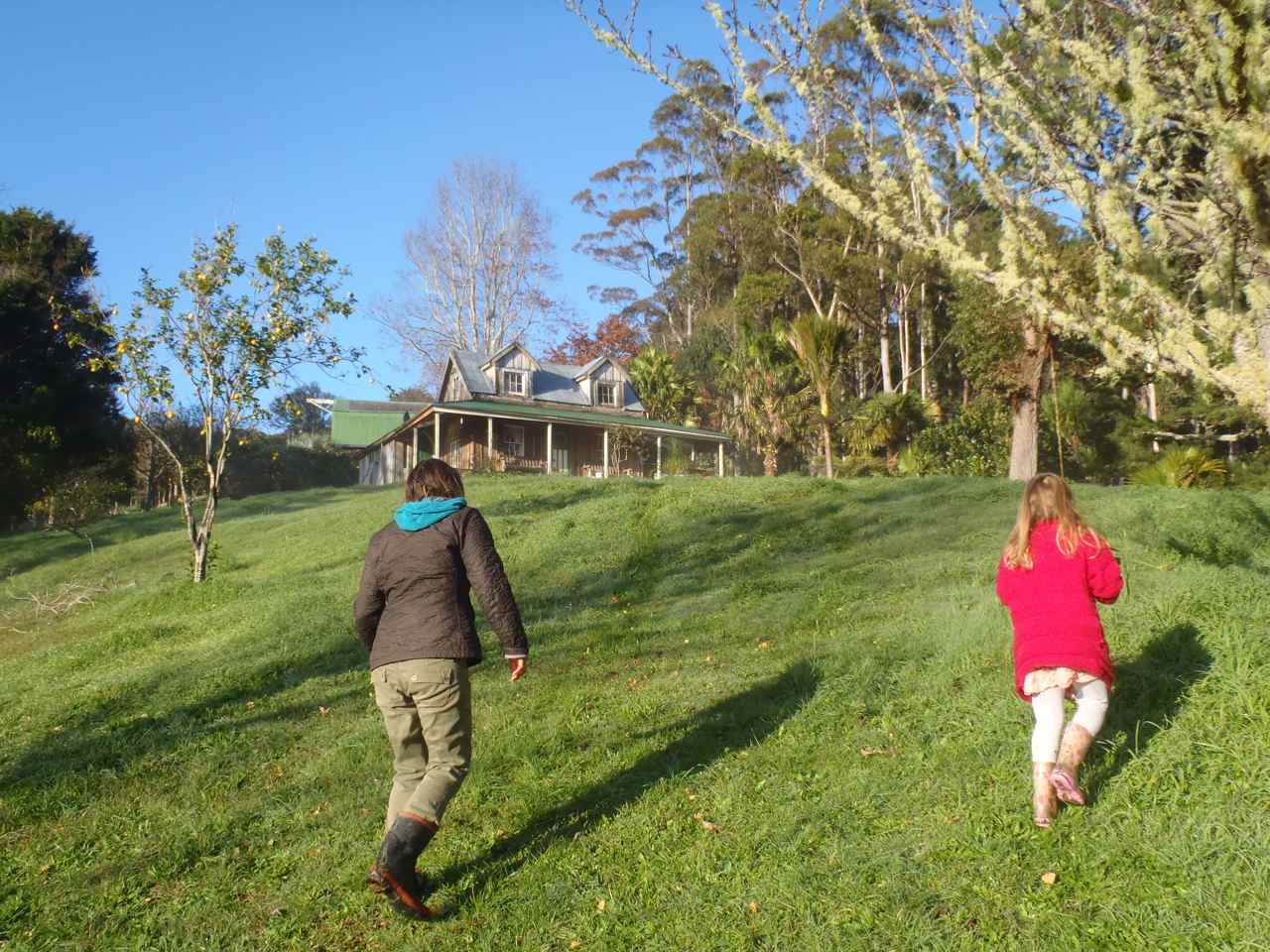
We felt like we were on the set of Lord of the Rings...

We had a chance to visit some amazing places and farms that are re-creating local economy and regional resilience.


Lothlorien Winery was the first Certified Organic orchard in New Zealand, back in the ‘70s. Started by Dale Demulemeester and friends, they decided to plant peaches and feijoas (pineapple guavas). The peaches sold great, but soon went out of production. The feijoas continued to thrive, so they planted more.

No roads to the house is quite refreshingThe "fridge"Jo grows bananas, in NZ!
Dale and a little milk for your coffee, straight from the udder

Now many hundreds of seedling trees are gracing the gently slopes of the Puhoi Valley. These trees are all genetically different from each other, and this imparts disease resistance to the farm and also a fine flavor to their wine. That’s right, organic sparkling feijoa wine.

Unfortunately you will have to travel to NZ to sample- no exports :(

While alcohol may be a luxury, lets be frank, it can be medicinal. One sip of this amazing concoction puts an ear-to-ear grin on your face. Best of all, its organic, truthfully.

Eli Demulemeester and a crate of liquid gold

Wine is not the only crop at Lothlorien. They have many citrus, pecan, macadamia, banana, avocado, a dairy cow, chickens, and vegetable gardens tended by Dale’s wife Jo. They also planted pines and eucalyptus on barren slopes 30 years ago, and now they are being harvested by the next generation to build their homes.

Eucalyptus flooring grown on site

What is behind the doors we left for the next generation?

Three generations of the Lothlorien clan live and work on the farm, tending trees and making wine. Eli and his brother and sister along with their families are taking the reigns of the farm from Dale.

Koko, Kim, Eli, and Tally Demulemeester

We then made our way south to Whaingaroa, the harbor more known for its surf spot than sustainability movement. Turns out its quite a little pocket of regional resilience.


Local crew are stepping up, with city parks turning into food forests, and organic farms popping up all over the region. They are also looking into microfinance and waste issues.

A young food forest in a local city park

Xtreme Waste was conceived by Liz and Rick Thorpe, the goal to reduce the local waste stream to zero. This is a feat in itself, deserving a separate blog entirely. As if this wasn’t enough to keep them busy, they also double as small-scale permaculture farmers.


Mixed fruit orchards surround a beautifully hand made house, ducks grazing beneath to keep the growth at bay and provide eggs. They plant vegetable crops like garlic, which we helped to separate for planting in a family style community atmosphere. They open the farm up every Tuesday to anyone who wants to come out and help.


Community is the cornerstone to local resilience, and this is also demonstrated in a big way at Kaiwhenua Gardens, run by Lynne and Kaiwaka Riti. Kaiwhenua translates directly to “Land of Food”, and Kaiwaka is the “Canoe of Food”, feeding the local whanau, family.

Kaiwaka Riti, tupuna of organics
Kai Whenua Gardens- Land of Food

Kaiwaka has started a revolution in the local area, by empowering young Maori who have lost their culture to the culture of the street and gangs to get back on the land and cultivate it. It is an amazing thing to see his passion and inspiration for his culture or whakapapa.

We arrived at Kaiwhenua the same time as local school kids came to get their hands dirty. We weeded around, and sampled delicious young carrots.

Possibly more eating than weeding took place...

We got a tour and met the kunekune pigs, who were happily weeding out kikuyu grass from under some trees. Kunekune are traditional Maori pigs, and are the only breed that can live off of grass exclusively.

Possibly the ugliest, and cutest animal at the same time

Kaiwhenua is also part of a new certification structure based on traditional Maori values. Hua Parakore, Pure Produce is a movement to take back the organic food standards from corporate interests.

Keepin' it Clean and Green in NZ!

Just down the road at the base of the point is another example of a community in action, this time an eco-retreat turned Permaculture Demonstration Site called SolScape.

Phil McCabe of SolScape holds up on of his experimental Earth Bricks

SolScape has been run by Phil and Bernadette McCabe for the last ten years as a backpackers with an eco twist, and now they are ready to take it to the next level. A collaboration with Otago University created the Practical Sustainable Living curriculum to be taught on site overlooking the majestic Tasman Sea.

Cool Caboose room

The property is 10 acres of mixed native bush and accommodation, with more and more vegetable gardens replacing the grass, and chickens running free. Recycled cabooses make cool rooms, and communal kitchens have earthen ovens built during Permaculture Design Courses.


We had a chance to join Phil for a tour with a group of American high school students with Global Adventures. We saw the eco-batch made from local and recycled materials, the earth bag domes, and the tipi site with solar hot water and composting toilets.


SWoBs is in discussion with SolScape about hosting Permaculture Surf Retreats on site. Participants will surf in the morning and learn in the afternoon, and a project will be created in the local community to help with local resilience. Stay tuned for more!

We got our hands dirty while in Waikato

We also wanted to mention our new friends with NZ Surf Tours, Judd and Ramona. We had the fortune of meeting them at Ahipara as hosts at the Endless Summer Lodge. Look them up and you are guaranteed to have a great adventure in Northland!


That's all for now, thanks for reading!